Proposal and Contract Automation for Agencies
Drew Rattray · Jun 8, 2026 · 12 min read

Quick Answer
Proposal and Contract Automation for Agencies is software that builds, sends, tracks, and gets signatures on proposals and client contracts without manual document work. For small agencies, it cuts proposal turnaround from days to under an hour, raises win rates by removing friction at signing, and connects to your CRM so deals move forward on their own. Most platforms cost between $39 and $149 per user per month.
Key Takeaways
- Automation replaces manual copy-paste work with reusable templates, dynamic pricing, and built-in e-signatures.
- Small agencies typically save 5 to 15 hours per week once templates are set up.
- Expect pricing between $39 and $149 per user per month for most agency-focused tools.
- The best platforms connect directly to HubSpot, Pipedrive, Salesforge, or your billing system.
- ResponseNow reports clients seeing a 40% increase in contract win rates after switching to automated workflows [6].
- Common mistakes include over-customizing templates, skipping legal review, and ignoring analytics.
- Agencies under 10 people benefit the most because owners are usually the bottleneck.
- Migration is easier than expected: most platforms import Word and PDF templates directly.
What Exactly Is Proposal Automation Software?
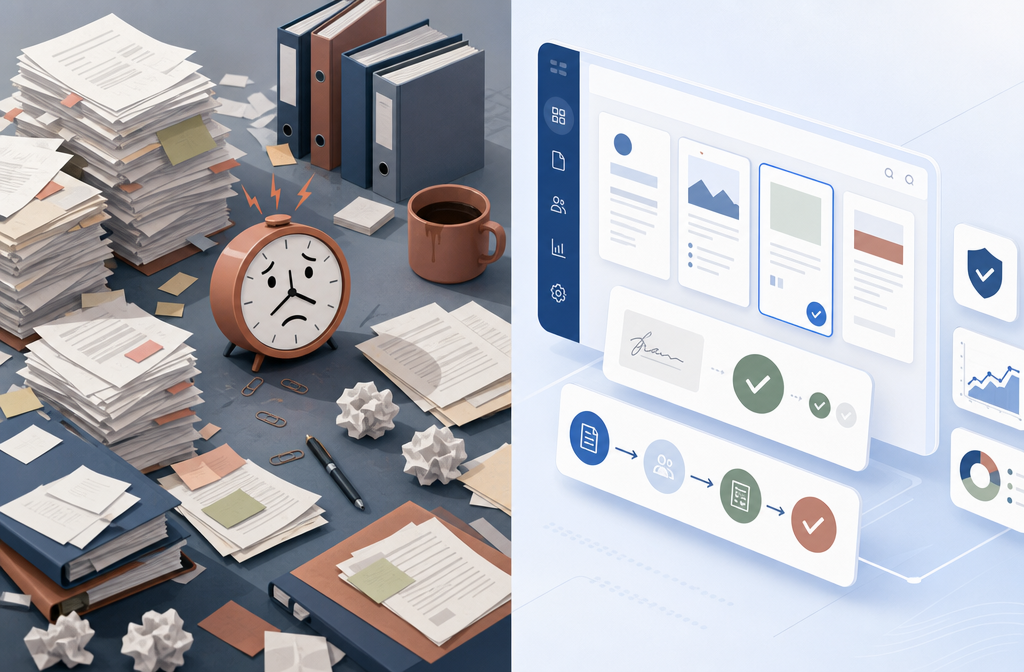
Proposal automation software creates, sends, and tracks client proposals using reusable templates, pre-approved content blocks, and built-in electronic signatures. Instead of rebuilding a Word document each time, you pick a template, swap in client details, and send a link the prospect can sign in their browser.
The category has expanded since 2023. Modern platforms now include:
- Content libraries with approved case studies and pricing tables
- Dynamic pricing tables clients can edit (pick add-ons, change quantities)
- E-signature with audit trail
- Open and view tracking
- CRM and accounting integrations
- AI drafting that writes a first pass based on a discovery call or brief
Tools like FlowEdge generate proposals, statements of work, and briefings in minutes by pulling from existing content and integrating with current tools [7]. For deeper background on stacking these tools with the rest of your operations, see the 2026 Agency Guide to Automation.
How Much Does Contract Automation Cost for Small Agencies?
Most agency-focused proposal and contract platforms cost between $39 and $149 per user per month, with annual plans typically 15 to 25 percent cheaper. Solo operators can find solid tools starting around $25 per month.
Here's a rough breakdown of what you get at each tier:
| Tier | Price range | Typical features | Best for |
|---|---|---|---|
| Starter | $25 to $49 per user | Templates, e-sign, basic tracking | Solopreneurs, freelancers |
| Growth | $49 to $99 per user | CRM sync, content library, payments | Agencies of 2 to 10 |
| Pro | $99 to $149 per user | AI drafting, approvals, analytics | Agencies of 10+ |
| Enterprise | $150+ per user | SSO, custom workflows, dedicated support | 50+ seat agencies |
Hidden costs to watch for: per-document fees, e-signature limits, and add-on charges for payment processing.
Which Proposal Tools Integrate With CRM Systems?
Most modern proposal platforms integrate with HubSpot, Pipedrive, Salesforce, Zoho, and Monday. The integration usually pushes contact data into the proposal and pulls signed contract status back into the CRM deal record.
When evaluating, ask three questions:
- Does it sync two ways, or only one direction?
- Can it trigger CRM stage changes when a proposal is signed?
- Does it pass line-item data to your accounting tool (QuickBooks, Xero)?
Ignition is one example built specifically around connecting proposals, contracts, and billing into one client agreement workflow with AI-driven pricing suggestions [3]. For government-facing agencies, Sweetspot consolidates capture, pipeline, and proposal writing into a single system, and its clients have collectively won over $3 billion in contracts [1].
Can Proposal Automation Help You Win More Clients?
Yes, primarily because speed and clarity at the signing stage are where most agency deals die. Automated proposals get to prospects faster, look more professional, and remove the print-sign-scan friction that delays decisions.
Three specific ways automation lifts win rates:
- Speed: Sending a polished proposal within 24 hours of the discovery call signals competence.
- Interactivity: Clients can pick package tiers themselves, which increases perceived control.
- Tracking: You see when a prospect opens the proposal and which sections they linger on, so follow-ups land at the right moment.
ResponseNow has reported clients seeing a 40% increase in contract win rates and major time savings per proposal after switching to its AI platform [6]. Results vary, but the directional lift is real.
What Are the Best Alternatives to Manual Proposal Creation?
The main alternatives to writing proposals from scratch in Word or Google Docs are: dedicated proposal software, all-in-one client management platforms, and CRM-native proposal modules.
Quick comparison:
- Dedicated proposal tools (PandaDoc, Proposify, Better Proposals): deepest features for proposals specifically.
- Client agreement platforms (Ignition, Bonsai, HoneyBook): combine proposals, contracts, invoices, and payments.
- CRM-native modules (HubSpot Quotes, Zoho CPQ): cheaper if you already pay for the CRM, but lighter on design and content reuse.
- AI-first platforms (FlowEdge, ResponseNow): focus on drafting speed using AI from a brief or call transcript.
Choose dedicated tools if proposals are a core deliverable. Choose all-in-one if you want fewer subscriptions. Choose CRM-native if you're price-sensitive and your proposals are simple.
Is Proposal Automation Worth It for Agencies Under 10 People?
For agencies under 10 people, proposal automation is usually one of the highest-ROI tools you can buy because the owner is almost always the proposal bottleneck. If you send four or more proposals a month, the math works out within the first quarter.
A simple rule of thumb:
- If you bill $100+ per hour and save 6 hours a month, that's $600 of recovered time for a $50 tool.
- If you close even one extra deal a quarter because of faster turnaround, the platform pays for itself for the year.
Skip it only if you send fewer than two proposals a month or your proposals are nearly identical and already take less than 30 minutes.

What Common Mistakes Do Agencies Make When Implementing Contract Tools?
The top mistakes are over-customizing templates before validating them, skipping legal review of the contract language, and treating the tool as a document generator instead of a sales system.
Watch out for:
- Building too many templates upfront. Start with two or three and refine.
- Copying legal terms from another agency's template. Have a lawyer review your master service agreement once.
- Ignoring the analytics. Open rates and time-on-section data are gold for follow-ups.
- Not training the team. If only the owner knows the tool, you've replaced one bottleneck with another.
- Forgetting renewal workflows. Automate the renewal reminder, not just the initial signature.
How Do You Choose the Right Proposal Automation Platform?
Pick the platform that matches your sales motion, not the one with the most features. Start with the integrations you need, then evaluate template flexibility, then pricing.
A practical five-step selection process:
- List your top 3 must-have integrations (CRM, accounting, payments).
- Write down your typical proposal structure and check that the platform supports it.
- Trial 2 platforms with a real proposal, not a demo.
- Send a test proposal to a friendly client for honest feedback.
- Commit to one for at least 90 days before reevaluating.
What Features Should You Look for in Contract Management Software?
For agency work, the non-negotiable features are: reusable templates, e-signature with audit trail, conditional pricing tables, CRM integration, and version history. Nice-to-haves include AI drafting, payment collection at signing, and approval workflows.
Feature checklist:
- Template library with variables and merge fields
- Legally binding e-signature (ESIGN and UETA compliant in the US)
- Interactive pricing (optional line items, quantity adjustment)
- Real-time collaboration and comments
- Open and view notifications
- Automatic reminders for unsigned proposals
- Renewal and expiration tracking
- Role-based permissions
Platforms like GovDash include built-in compliance checks alongside proposal generation, which matters more for regulated sectors but signals the depth of features available [8].
How Much Time Can Proposal Automation Actually Save?
Most small agencies save 5 to 15 hours per week within 60 days of full adoption. The savings come from three places: template reuse, eliminated formatting work, and removed back-and-forth on revisions.
Sweetspot has reported a tenfold increase in proposal drafting speed for its government contractor clients [1]. RFP ProAI reports saving over 10 hours per proposal for complex RFP responses [9]. For typical agency proposals, expect to drop a 4-hour task to 30 to 45 minutes once templates are dialed in.
Which Industries Benefit Most From Proposal Automation?
The industries with the highest payoff are professional services agencies (marketing, design, dev, PR), consultants, legal and accounting firms, government contractors, and managed service providers. Anyone who sends structured proposals with similar deliverables across clients sees fast returns.
Highest-ROI use cases:
- Marketing and creative agencies with packaged retainers
- Web development shops with scoped project tiers
- Consultants with productized offerings
- Government contractors responding to RFPs (where tools like GovSignals, the first AI proposal platform with FedRAMP High authorization, serve federal compliance needs) [2]
- MSPs renewing annual service agreements
What Are the Risks of Using Automated Proposal Systems?
The real risks are template drift, legal exposure from outdated clauses, and over-reliance on AI drafts that contain errors. None are dealbreakers, but each needs a process.
Key risks and mitigations:
- Outdated legal terms: Schedule a quarterly template review.
- AI hallucinations in drafts: Always have a human approve before sending.
- Vendor lock-in: Export your templates and contract archive monthly.
- Data security: Confirm SOC 2 compliance, especially if handling regulated client data.
- Generic-feeling proposals: Keep one or two sections genuinely custom per proposal.
How Do You Migrate Existing Proposals Into an Automation Platform?
Migration is straightforward for most agencies. Start by picking your three best-performing past proposals, then rebuild them as templates in the new platform rather than importing them as-is.
Five-step migration approach:
- Audit your last 10 proposals and identify common sections.
- Build a master template with variables for client name, scope, and pricing.
- Create a content library of reusable sections (about us, case studies, terms).
- Import your contract MSA as a separate template, reviewed by a lawyer.
- Run the next 3 proposals through the new system in parallel with your old process for safety.
Most platforms accept Word, Google Docs, and PDF imports, so you don't need to start from a blank page.
FAQ
Is e-signature legally binding for agency contracts? Yes, in the US under the ESIGN Act and UETA, electronic signatures are legally equivalent to handwritten ones for nearly all business contracts.
Can I use one tool for both proposals and contracts? Yes. Most modern platforms handle both, often combining them into a single signable document.
How long does setup take? Plan on 4 to 8 hours of focused work to build your first templates and integrate with your CRM.
Do clients need an account to sign? No. Clients receive a link, review the document in their browser, and sign without creating an account.
Will it work for international clients? Yes, but check that the platform supports your clients' local e-signature laws (eIDAS for the EU, for example).
Can I collect payments through the proposal? Many platforms now include Stripe or ACH payment collection at the signing stage, which speeds up cash flow.
What if my proposals are highly custom? You can still benefit. Use templates for the standard 70% (about, terms, pricing structure) and write the custom scope fresh each time.
Is AI-generated proposal content safe to send? Only after human review. Use AI for first drafts, not final copy.
Conclusion
Proposal and contract automation is one of the few agency investments that pays back inside a quarter for almost any small team that sends proposals regularly. The combination of faster turnaround, professional presentation, and tracked engagement directly raises win rates without requiring you to hire anyone new.
Next steps:
- Audit your last 10 proposals: how long did each take, and how many won?
- Pick two platforms from the comparison above and start free trials this week.
- Rebuild your top-performing proposal as a template inside both tools.
- Send your next real proposal through the winning platform and measure the difference.
Start small, validate with one workflow, then expand. The agencies that win in 2026 are the ones that turn admin work into systems and keep their best hours for client work.
References
[1] Sweetspot - https://www.sweetspot.so/?utm_source=openai [2] GovSignals - https://www.govsignals.ai/?utm_source=openai [3] Ignition - https://www.ignitionapp.com/?utm_source=openai [4] RFPCapturePro - https://www.rfpcapturepro.com/?utm_source=openai [5] Apex Logic - https://www.apexlogic.com/?utm_source=openai [6] ResponseNow - https://responsenow.co/?utm_source=openai [7] FlowEdge - https://getflowedge.com/?utm_source=openai [8] GovDash Federal - https://www.govdash.com/federal?utm_source=openai [9] RFP ProAI - https://rfpproai.com/?utm_source=openai [10] GovOps360 - https://govops360.com/?utm_source=openai
Meta Title: Proposal and Contract Automation for Agencies: 2026 Guide
Meta Description: Proposal and Contract Automation for Agencies cuts proposal time by 80%. Compare costs, features, and tools built for small agencies in 2026.
Tags: proposal automation, contract automation, agency software, proposal software, e-signature tools, CRM integration, agency operations, client contracts, proposal templates, sales automation, small agency tools