The 2026 Agency Guide to Automation
Drew Rattray · Apr 3, 2026 · 14 min read

Quick Answer
Agency automation is how a lean agency handles more clients without hiring more people. It uses software, AI agents, and connected workflows to do the repetitive work (chasing leads, sending follow-ups, building reports, collecting payment) so your team can focus on strategy and creative. In 2026, roughly 47% of marketing agency admin and operational tasks are already automated, and the gap between agencies that adopt it and those that don't is widening fast.
Key Takeaways
- Agency automation replaces repetitive work with software, not people. It's how small teams compete with bigger ones.
- The highest-ROI areas are billing, client onboarding, and campaign reporting.
- Top tools in 2026 embed task-specific AI agents directly into agency workflows. Around 40% of enterprise apps are expected to ship with these by year-end [2].
- AI-powered personalization is driving 82% higher conversion rates on automated campaigns versus standard ones.
- Lean agencies are doubling output without adding headcount.
- The 12 systems in this guide cover lead capture, booking, nurture, content, support, onboarding, reporting, voice, proposals, reviews, and payments.
- You don't need to build all 12 at once. Start with the one that's costing you the most sleep.

What Exactly Is Agency Automation and How Does It Work?
Agency automation is a stack of connected tools that trigger actions based on events. A lead fills a form, the system replies, books a call, sends a contract, and creates a project, all without anyone touching a keyboard.
Think of it like plumbing. Each tool is a pipe. The water (your client data, leads, tasks) flows from one to the next. The agency owner's job is to lay the pipes once, then let them run.
Most agency automation today combines three things:
- Triggers, like a new form submission or a missed call.
- Actions, like sending an email, booking a meeting, or generating an invoice.
- AI agents that handle the judgment calls in between, such as qualifying a lead or drafting a personalized reply.
The result is a workflow that runs 24/7 and doesn't get tired on a Friday afternoon.
How Much Does Agency Automation Software Typically Cost?
A practical agency automation stack in 2026 costs between $200 and $2,000 a month, depending on size and how much you build versus buy. Lifetime deals can drop that to a one-time payment of $300 to $1,500 for the core tools.
Here's a rough breakdown for a small agency:
| Tier | Monthly cost | What you get |
|---|---|---|
| Starter (solo) | $50 to $250 | Scheduler, email automation, basic CRM, Zapier or Make |
| Growth (3 to 10 staff) | $300 to $900 | Above plus AI chatbot, reporting dashboards, proposal tool |
| Established (10+ staff) | $1,000 to $2,500+ | Full stack with voice agents, white-label client portals, dedicated automation platform |
The marketing automation sector is on track to hit $13.71 billion by 2030, so pricing pressure is real and tooling keeps getting cheaper per feature.
Which Automation Tools Are Best for Marketing vs Creative Agencies?
Marketing agencies lean on tools that handle leads, campaigns, and reporting. Creative agencies lean on tools that handle production, approvals, and asset delivery. The stacks overlap but the priorities don't.
- Marketing agencies prioritize: CRM automation, ad reporting dashboards, email nurture, lead scoring, and AI content generation.
- Creative agencies prioritize: project intake, file collection, client review and approval, proofing, and invoicing.
A useful rule: if your agency sells outcomes (leads, revenue, traffic), automate the measurement loop first. If your agency sells deliverables (videos, designs, websites), automate the production and approval loop first.
Can Small Agencies Really Benefit From Automation or Is It Just for Big Firms?
Small agencies benefit more, not less. A solo operator or three-person shop has no slack to absorb the repetitive work, so every hour saved is an hour earned. Automation is what lets a five-person agency punch at the weight of a twenty-person one.
Agencies adopting AI-powered automation have doubled production volume without adding staff [2]. That's the entire pitch in one sentence. The big firms have layers of process and people; you have software and a clear head.
If you're solo, start with two automations: instant lead reply and automated booking. Those two alone will pay for the rest.
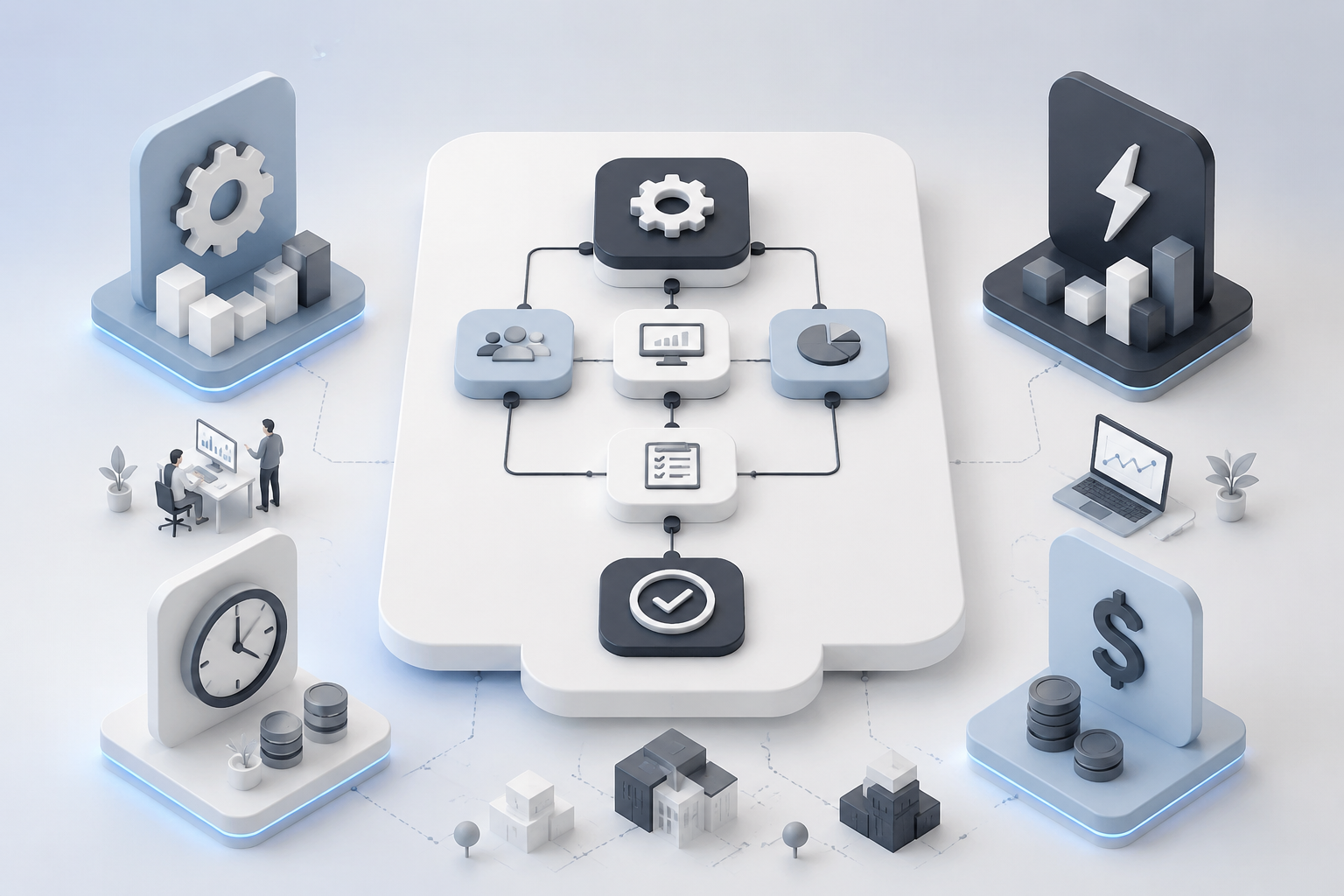
What Tasks Can Be Automated in a Typical Agency Workflow? The 12 Systems
Below are the 12 agency automation systems that matter most in 2026. Each one gets a deeper article. This is the map.
1. Lead Response Automation (Speed to Lead)
What it is: Instantly replying to new leads the moment a form is filled, a DM lands, or a call is missed.
Why it matters: Leads go cold in minutes. Whoever replies first usually wins the deal. Most agency replies are too slow because they depend on a human seeing a notification.
A simple speed-to-lead workflow can lift booked-call rates significantly without any change in ad spend. Deep dive coming in the lead response automation article.
2. Appointment Booking and No-Show Recovery
What it is: Automated scheduling, reminders, and sequences that win back no-shows.
Why it matters: Every empty slot on your calendar is lost revenue. Manual reminders get forgotten, and no-shows rarely get rebooked unless something triggers it for you. AI voice agents are now handling appointment reminders directly, which is a notable shift from 2025.
3. Email Nurture Automation
What it is: Sequences that warm leads, stay in front of past clients, and re-engage cold contacts without anyone hitting send.
Why it matters: Follow-up is where most agency revenue hides, and it's the first thing that gets dropped when you're busy. AI-driven personalization in nurture sequences is now driving 30% higher open rates and 50% higher click-through rates versus standard campaigns.
4. Landing Page Automation
What it is: Pages that capture leads, route them by intent, and trigger the right next step automatically.
Why it matters: A landing page is only as good as what happens after the form is filled. If the lead waits two hours for a reply, the page didn't really work.
5. Social Media and Content Scheduling Automation
What it is: Planning, generating, scheduling, and publishing content across channels on a regular cadence.
Why it matters: Consistency wins on social and consistency is hard to maintain by hand. Generative AI has cut content creation cycles by 60% to 80%, so the bottleneck is now scheduling and approval, not writing.
6. AI Customer Service Agents and Chatbots
What it is: Chat agents that answer questions, qualify visitors, and book calls 24/7.
Why it matters: Prospects expect instant answers, day or night. A good chat agent acts like your best junior account person, except it never sleeps and never forgets the FAQ.
7. Client Onboarding Automation
What it is: Automated intake forms, welcome sequences, asset collection, and project kickoff.
Why it matters: A smooth start sets the tone for the entire engagement and saves hours per client. Onboarding is one of the top three highest-ROI areas for agency automation.
8. Reporting and Client Dashboard Automation
What it is: Reports and live dashboards that build themselves from your ad platforms, analytics, and CRM.
Why it matters: Clients want to see results. Pulling reports by hand every month burns hours and breeds errors. Campaign reporting is in the top three ROI areas alongside billing and onboarding.
9. Voice Agent Automation
What it is: AI voice agents that answer calls, qualify callers, book appointments, and send reminders.
Why it matters: A missed call is often a missed client. Voice agents are now mature enough to handle real conversations, not just IVR menus, and the gap between "robot" and "receptionist" is closing fast.
10. Proposal and Contract Automation
What it is: Templates, dynamic fields, e-signatures, and post-signature triggers that create the project automatically.
Why it matters: A proposal that goes out the same day closes more often than one that takes a week. Automation removes the back-and-forth between sales and ops.
11. Review and Reputation Management Automation
What it is: Sequences that ask happy clients for reviews at the right moment and route unhappy ones to support first.
Why it matters: Reviews compound. One automated ask after a milestone is delivered will outproduce a quarterly "we should ask clients for reviews" team meeting every time.
12. Invoicing and Payment Automation
What it is: Automatic invoice generation, payment links, retries on failed cards, and dunning sequences.
Why it matters: Billing is the number one highest-ROI area for agency automation [1]. Late payments are usually a process problem, not a client problem.
Top 5 Agency Automation Platforms Compared
Here's a quick comparison of platform categories agencies are using in 2026. These aren't the only options, but they cover most stacks.
| Platform type | Best for | Strengths | Watch-outs |
|---|---|---|---|
| All-in-one (HubSpot, GoHighLevel) | Marketing agencies wanting one login | CRM, email, pages, reporting in one place | Lock-in, learning curve, white-label limits |
| Workflow builders (Make, Zapier, n8n) | Agencies with custom needs | Connect anything to anything | Requires someone who likes building |
| AI agent platforms (BlipAI, custom GPTs) | Solo operators and small teams | Quick wins, fast to deploy | Often shaped for one user, not 50 clients |
| Scheduling and voice (Lunacal, voice agents) | Service agencies with calls | High-leverage, low-effort wins | Integration depth varies |
| Client portal and reporting (white-label dashboards) | Agencies reselling to clients | Looks professional, scales billing | Check white-label depth carefully |
A note on lifetime deals: many of the AI tools you'll see promoted in 2026 were never shaped for agency use. Check white-label, sub-accounts, and reseller permissions before you buy.
How Much Time and Money Can Agencies Save With Automation?
Most agencies that fully implement the 12 systems above save 15 to 30 hours per week across the team and reclaim 10% to 25% of revenue that was previously leaking through slow follow-up, missed calls, and unpaid invoices.
Hard numbers from the field:
- Content production cycles down 60% to 80% with generative AI in the loop.
- Conversion rates up 30% to 40% on agentic AI workflows that orchestrate the full customer journey.
- 82% higher conversion rates on hyper-personalized campaigns versus standard ones.
- Production volume doubled without adding headcount at AI-forward agencies.
The savings compound. The first automation you ship pays for the next three.
How Do I Know If My Agency Is Ready for Automation?
You're ready when you can answer yes to at least three of these:
- You handle more than 20 leads a month.
- You have a repeatable service (not bespoke every time).
- You've written the same email more than ten times.
- You've missed a lead or a payment because of slow process.
- You're considering hiring just to handle admin.
If you said yes to four or five, you're past ready. You're behind.
If you said no to all five, you're probably too early. Get a few clients first, find the repetition, then automate it.
What Skills Does Your Team Need to Use Agency Automation Tools?
The good news: in 2026, most agency automation tools are no-code or low-code. Your team needs curiosity more than coding skills.
Practical skills that matter:
- Process thinking. Can someone map out a workflow on paper?
- Basic data sense. Knowing what a CSV is and how fields connect.
- Comfort with AI prompts. Writing a clear instruction to a chatbot or agent.
- Patience to test. Most automations need three or four iterations to be reliable.
You don't need a developer for 90% of agency automation work. You do need one person on the team who owns it and cares about it working.
What Are the Most Common Mistakes Agencies Make When Implementing Automation?
The mistakes are predictable and avoidable. The biggest one is automating a broken process. If your manual onboarding is messy, automating it just makes the mess faster.
Common mistakes:
- Buying tools before mapping the workflow. Sketch it on paper first.
- Automating everything at once. Pick one system, ship it, then move on.
- No owner. If nobody owns the automation, it breaks quietly.
- Skipping the "what happens when it fails" question. Every automation needs a fallback.
- Falling for the demo. A polished demo is not a production-ready tool, especially with lifetime deals.
- Forgetting white-label. If you're reselling, check this on day one.
Are There Any Downsides or Risks to Agency-Wide Automation?
Yes. Automation amplifies whatever you point it at. Point it at a broken process and you scale the breakage. A few real risks:
- Tool sprawl. Buying ten tools that overlap and integrating none of them.
- Over-automated client experience. Clients can tell when nobody's home. Keep humans on the high-stakes touchpoints.
- Data lock-in. Some platforms make it hard to export your client data.
- Vendor risk. Especially with lifetime deals, the founder can go quiet and the roadmap can stall.
- Compliance. Voice agents and chatbots need clear disclosure in many regions.
The mitigation is the same in every case: pick fewer tools, test them under real load, and keep a human in the loop where it matters.
Will Automation Replace Human Workers in Agencies?
No, but it will reshape what humans do. Automation is replacing repetitive tasks, not roles. The account manager who used to spend ten hours a week on reporting now spends that time on client strategy. The same person, doing higher-value work.
The agencies that thrive in 2026 treat AI and automation as a team member, not a replacement. The ones that try to automate the human relationship out of the business tend to lose clients.

Case Studies of Agencies That Transformed With Automation
Specific case studies vary, but the pattern is consistent across the agencies adopting these systems in 2026:
- A solo marketing operator using AI agents and workflow automation has doubled client capacity without hiring, mirroring the broader trend of AI-forward agencies doubling production volume [2].
- Boutique agencies that automated billing, onboarding, and reporting (the three highest-ROI areas) have reported recovering one to two days a week per account manager [1].
- Creative shops using AI for content generation and personalization have cut creative production cycles by more than half.
The takeaway: the wins are real, the numbers are public, and the playbook is no longer a secret.
FAQ
What is agency automation in simple terms? It's using software to do the repetitive work in your agency, like replying to leads, sending follow-up emails, booking calls, and invoicing, so you don't have to.
Where should an agency start with automation? Start with lead response and appointment booking. They have the fastest payback and the lowest risk. Once those run themselves, move to onboarding and reporting.
How long does it take to set up agency automation? A single workflow takes a few hours to a few days. A full 12-system stack takes one to three months if you go one at a time, which is the way to do it.
Do I need to know how to code? No. Most tools in 2026 are no-code. You'll need patience and process thinking more than technical skills.
What's the difference between automation and AI? Automation runs predefined steps. AI makes judgment calls inside those steps, like qualifying a lead or drafting a personalized email. Modern agency automation uses both together.
Can I automate client communication without sounding robotic? Yes, if you write the templates in your voice and use AI for personalization, not for replacing the relationship. Keep humans on the high-stakes moments.
Are lifetime deals on automation tools worth it? Sometimes. Many are not shaped for agency use, especially around white-label and multi-client management. Check those specifically before you buy.
How do I measure ROI on automation? Track hours saved per week, response time to leads, no-show rate, and percentage of invoices paid on time. Compare before and after at the 60-day mark.
Conclusion: Where to Start
Agency automation in 2026 is not optional anymore. Almost half of agency admin work is already automated across the industry, and the agencies that hold out are quietly losing ground on response time, client experience, and margin.
You don't need all 12 systems on day one. Here's a sensible order:
- This month: Lead response and appointment booking. Fastest payback.
- Next 60 days: Client onboarding, email nurture, and reporting.
- Next 90 days: Invoicing, proposals, and reviews.
- Then: Voice agents, chatbots, content scheduling, landing pages.
Pick one. Ship it. Measure the time saved. Move to the next.
The agencies that win the next three years won't be the biggest. They'll be the ones who built the cleanest pipes and let the work flow.