
Email Nurture Automation: A Guide for Agency Owners
Drew Rattray · Apr 24, 2026 · 10 min read

Email Nurture Automation: A Guide for Agency Owners
Last updated: June 10, 2026
Quick Answer
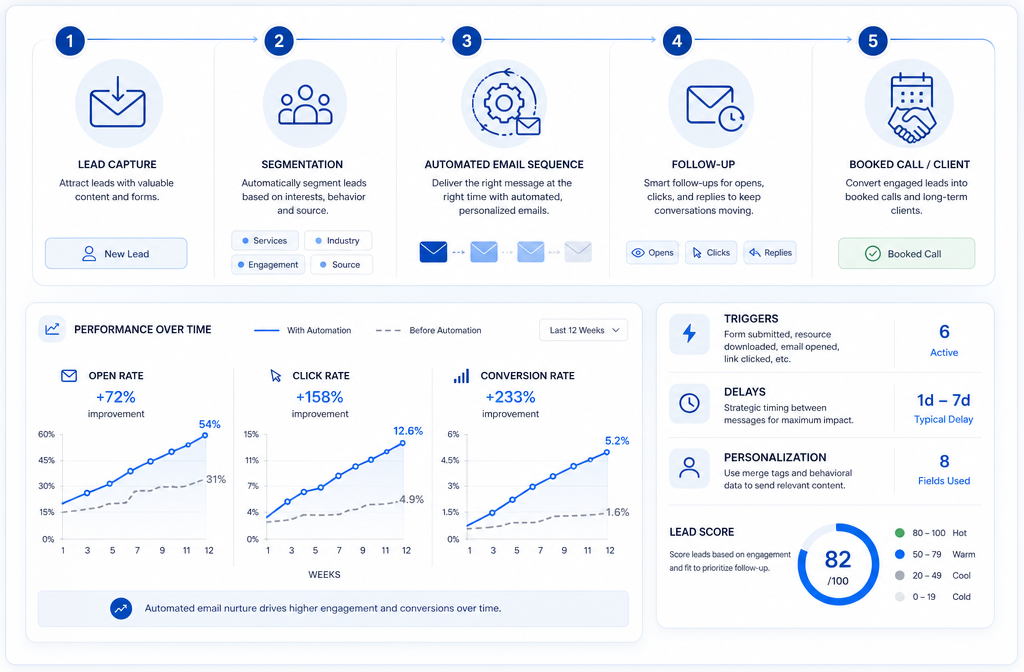
Email nurture automation for agencies is a system of triggered, sequenced emails that move leads from first contact to signed contract without manual follow-up. For small agencies, it typically costs $20 to $300 per month in software, takes two to four weeks to set up properly, and pays back within 60 to 90 days when tied to a real sales process. The fastest wins come from three workflows: speed-to-lead replies, post-discovery follow-ups, and re-engagement of cold prospects.
Key Takeaways
- Email nurture automation sends the right message at the right time based on lead behavior, not a calendar.
- Document your sales process before automating anything. Automating a broken funnel just breaks it faster.
- Most agencies need three to five core workflows, not twenty.
- Budget $50 to $200 per month for software at the small-agency stage.
- Track reply rate and pipeline value, not just opens.
- Segment by service interest and lifecycle stage at minimum.
- B2B agencies need longer, content-rich sequences. B2C agencies lean on shorter, offer-driven flows.
- Personalization beats volume every time.
What Exactly Is Email Nurture Automation for Agencies
Email nurture automation is software that sends pre-written email sequences to leads based on triggers like form fills, link clicks, or time delays. For agencies, it replaces the manual "I'll follow up next week" promise that rarely happens. A lead downloads your pricing guide, and over the next 14 days they receive five emails: a delivery email, a case study, a common-objection answer, a discovery call invite, and a final check-in.
The goal is to keep prospects warm during their decision window, which for most agency services runs 30 to 90 days. Done well, it feels like timely, helpful conversation. Done badly, it feels like spam. This guide is one chapter of The 2026 Agency Guide to Automation, which covers the broader systemization picture.
Decision rule: If you forget to follow up with leads more than twice a month, you need nurture automation.
How Much Does Email Nurture Automation Software Cost
Most small agencies spend between $20 and $300 per month on email automation software, depending on contact list size and feature needs. Entry tools like MailerLite or Brevo start near $20 monthly for under 1,000 contacts. Mid-tier platforms like ActiveCampaign or HubSpot Starter run $50 to $200. Full CRM-and-email suites like HubSpot Professional or Go High Level sit at $300 to $900 monthly.
| Tier | Monthly Cost | Best For |
|---|---|---|
| Starter | $20 to $50 | Solopreneurs, under 2,000 contacts |
| Growth | $50 to $200 | 2 to 10 person agencies |
| Pro | $200 to $900 | Agencies managing client email too |
Add setup costs of $0 to $3,000 if you hire help. Most agency owners can self-implement a starter system in a weekend.
Mailchimp vs Constant Contact for Agency Email Nurturing
Mailchimp is the stronger choice for agencies that need behavior-based automation and visual workflow builders. Constant Contact is simpler and better for agencies running mostly broadcast newsletters with light automation. Mailchimp's free tier covers 500 contacts. Constant Contact has no free tier but offers easier event and survey tools.
For nurture specifically, Mailchimp wins on conditional logic, audience segmentation, and integrations. Constant Contact wins on customer support and onboarding for non-technical users. Neither is the best agency tool overall, but both work fine at the starter stage.
Choose Mailchimp if: you want automation flexibility and plan to grow into multi-step workflows. Choose Constant Contact if: you mostly send a monthly newsletter and want phone support.
Best Email Automation Tools for Digital Marketing Agencies in 2026
The top email automation platforms in 2026 for agencies are ActiveCampaign, HubSpot, Go High Level, Brevo, and Klaviyo (for e-commerce clients). Each fits a different agency profile.
- ActiveCampaign: Best balance of price and automation depth. Strong for B2B service agencies.
- HubSpot: Best if you want CRM, email, and reporting in one place. Pricey at scale.
- Go High Level: Built for agencies that resell marketing tools to clients. Includes SMS, calls, and white-labeling.
- Brevo (formerly Sendinblue): Best low-cost option with solid automation.
- Klaviyo: Best for agencies serving e-commerce brands.
- n8n or Make: Use these to connect email tools to forms, CRMs, and Slack without code.
How to Set Up an Effective Email Nurture Workflow
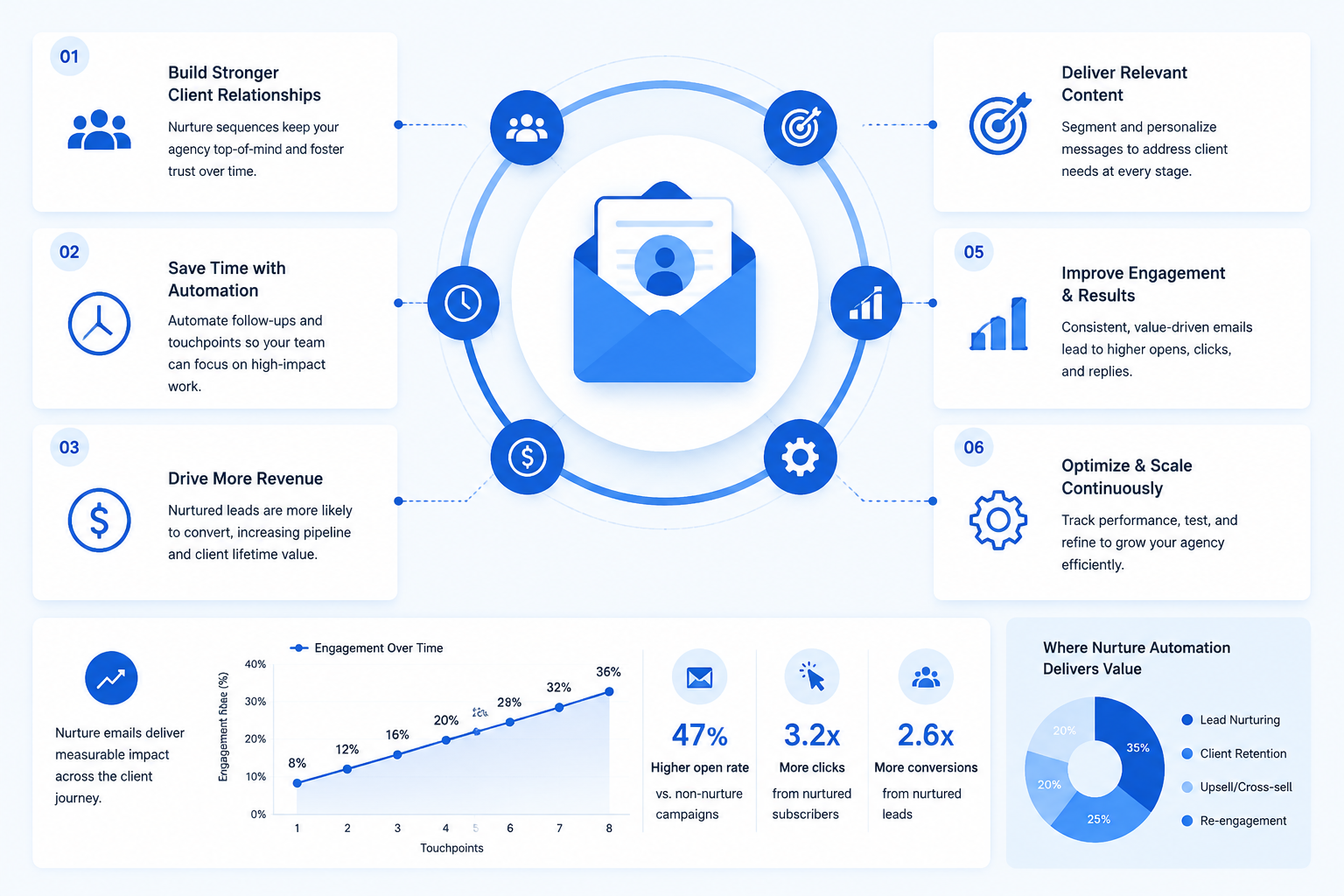
Build your first nurture workflow in five steps, in this order: define the goal, pick the trigger, write the emails, set delays and conditions, then test before launch.
- Define the goal. Book a discovery call? Get a reply? Resell to a past client? One goal per sequence.
- Pick the trigger. Form submission, tag added, link clicked, or date-based.
- Map the audience and stage. Cold lead, warm lead, post-proposal, or churned client.
- Write 4 to 7 emails. Each needs a short subject line, one main idea, personalized opening, clear CTA button, and unsubscribe link [2]. Include plain-text version and image alt text.
- Set delays. Day 0, Day 2, Day 5, Day 9, Day 14 is a common B2B agency cadence.
- Test with real data. Send to yourself and two team members before going live.
Follow the order: eliminate unnecessary steps, document the process, then automate, then delegate [1]. Automating a messy process locks the mess in.
Common Mistakes Agencies Make With Email Nurture Campaigns
The biggest mistake is automating before documenting. Agencies build complex workflows around a sales process they cannot explain on paper, then wonder why conversion stays flat. Other frequent errors:
- Sending the same email to every lead regardless of service interest.
- Writing emails that sound like brochures instead of conversations.
- No clear CTA, or three competing CTAs in one email.
- Ignoring replies. Automation should route human responses to a real inbox.
- Skipping the plain-text version and accessibility basics.
- Measuring opens only. Open rates are unreliable since Apple Mail Privacy Protection.
- Building 12-step sequences when 5 steps would convert better.
Common edge case: A lead replies to email two of a seven-email sequence. If the automation keeps sending the rest, you look careless. Always pause sequences on reply.
Is Email Nurture Automation Worth It for Small Agencies
Yes, for almost any agency generating more than five inbound leads per week. Below that volume, manual follow-up is fine and automation is overkill. Above it, leads slip through the cracks and the cost of one lost retainer easily exceeds a year of software fees.
Agencies that benefit most:
- B2B service agencies with sales cycles over 30 days.
- Agencies running paid lead-gen campaigns.
- Agencies with productized services or recurring offers.
- Agencies that publish content and capture email signups.
Agencies that benefit least: project-based studios with all referral business and zero outbound effort.
How Do I Track ROI on Email Nurture Campaigns
Track ROI by attributing closed revenue back to the nurture sequence that touched the lead before signing. The simplest method: tag each lead with their entry source, then in your CRM mark which deals came from nurtured contacts versus cold or direct.
Core metrics to track monthly:
| Metric | What It Tells You |
|---|---|
| Reply rate | Whether emails feel human |
| Click rate | Whether CTAs are clear |
| Meetings booked | Whether sequences drive action |
| Pipeline value | Dollar value of nurtured deals |
| Closed revenue | Final ROI |
| Unsubscribe rate | Whether targeting is off |
Aim for reply rates above 3 percent on cold sequences and 10 percent on warm. If pipeline value from nurture covers software cost by 10x, the system is healthy.
What Metrics Should I Track for Email Nurture Campaigns
Beyond ROI, track engagement and list health weekly. Open rate is now a weak signal, so weight clicks, replies, and conversions higher. Watch unsubscribe rate and spam complaint rate. A spam rate above 0.1 percent will hurt deliverability across all your sends.
Set baselines after 30 days, then optimize one variable at a time. Change the subject line one week, the CTA the next. Avoid changing five things at once.
How to Segment Email Lists for Better Agency Nurturing
Segment at minimum by lifecycle stage and service interest. A lead who downloaded your SEO guide should not receive your web design case studies. Useful segmentation layers:
- Lifecycle stage: new lead, engaged lead, proposal sent, client, churned.
- Service interest: based on which lead magnet or page they engaged with.
- Company size or industry: for B2B agencies.
- Engagement level: active, dormant, cold.
- Source: referral, paid ad, organic, event.
Start with two or three segments. Adding more before you have content for each just creates empty buckets.
Email Nurture Automation for B2B vs B2C Agencies
B2B agencies need longer, education-heavy sequences focused on building trust over weeks. B2C agencies need shorter, offer-driven sequences focused on quick decisions. The structures differ significantly.
B2B agency nurture: 7 to 12 emails over 30 to 60 days. Case studies, ROI calculators, comparison guides, founder thought leadership. CTA is usually a discovery call.
B2C agency nurture: 3 to 5 emails over 5 to 14 days. Social proof, limited-time offers, product demos. CTA is usually a purchase or booking.
If your agency serves both, build separate workflows. Do not try one sequence for everyone.
FAQ
How many emails should a nurture sequence have? For B2B agencies, 5 to 9 emails over 14 to 45 days works well. For B2C, 3 to 5 emails over a week.
How often should I update nurture content? Review every 90 days. Replace any email with under 10 percent click rate or outdated examples.
Should automation pause on a reply? Yes, always. Continuing to send automated emails after a human reply damages trust.
Can I run nurture for my clients too? Yes. Many agencies resell email automation to clients using Go High Level or HubSpot partner plans.
What is speed-to-lead? An automated reply to new inquiries within 5 minutes of form submission. It is one of the highest-ROI agency workflows.
Do I need a CRM with my email tool? For agencies past $200k in revenue, yes. Below that, a connected email tool with tagging is enough.
How long until I see results? First conversions usually appear within 30 days. Reliable ROI signal needs 60 to 90 days of data.
What is the single best first workflow to build? Speed-to-lead. Instant reply to inbound inquiries, then a 5-email warm-up sequence.
Conclusion
Email nurture automation works when it follows a real sales process and breaks when it tries to replace one. Start by documenting how you actually win clients today, then automate the two or three follow-ups you keep forgetting. Pick one tool in your budget, build one workflow, measure replies and pipeline for 60 days, then expand.
Next steps:
- Write down your last five closed deals and the touchpoints that led to each.
- Pick one entry point (a lead magnet, contact form, or discovery call no-show) to automate first.
- Choose a starter platform that fits your contact volume and budget.
- Build a 5-email sequence this week. Launch it next week.
- Review metrics at day 30 and adjust.
The agencies winning in 2026 are not the ones with the fanciest tech stacks. They are the ones who respond fast, follow up consistently, and treat every lead like a real person.