AI Customer Service Agents and Chatbots for Agencies
Drew Rattray · May 15, 2026 · 11 min read

Quick Answer
AI customer service agents and chatbots for agencies are software systems that handle client and end-customer conversations using large language models, automation rules, and connections to your CRM or helpdesk. For small agencies, they typically cost 60 to 90 percent less than expanding a human support team and can resolve routine questions in seconds. The catch: 74 percent of companies have rolled back at least one AI agent due to governance issues, so setup, training, and human oversight matter more than the tool you pick.

Key Takeaways
- AI agents work best for repetitive, well-documented tasks like FAQs, booking, lead qualification, and order status checks.
- Expect a working pilot in roughly 14 days when you start with one narrow use case.
- Budget for a small agency typically ranges from 50 to 500 USD per month for SaaS chatbots, plus optional setup fees.
- Integration with your CRM, helpdesk, and messaging channels is what separates a useful agent from a glorified FAQ widget.
- Privacy, hallucinations, and lack of auditability are the top three reasons AI agents get pulled from production.
- Humans should keep handling refunds with judgment calls, complaints, sensitive accounts, and any conversation where trust matters more than speed.
What Exactly Are AI Customer Service Agents and How Do They Work
An AI customer service agent is software that reads a customer message, decides what the customer wants, and either answers directly or takes an action like creating a ticket, booking a meeting, or updating a record. Chatbots are the simpler cousin: rule-based or lightly AI-assisted scripts that follow set flows.
Modern agents combine three layers:
- A large language model that understands and generates natural language.
- A knowledge base (your help docs, FAQs, past tickets) the model can search.
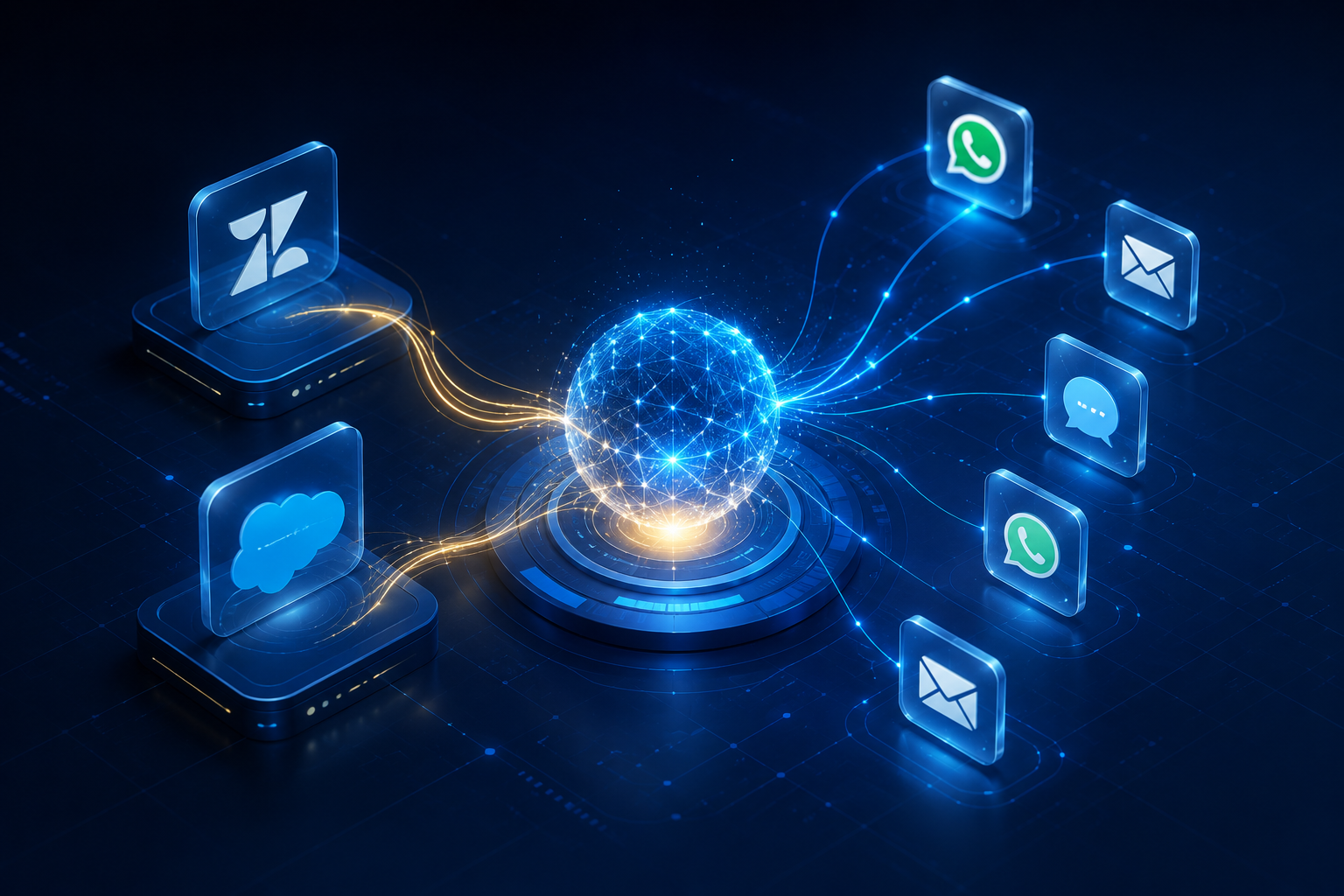
- Tools and APIs that let the agent do things, not just talk, such as pulling a customer record from your CRM or scheduling through your calendar.
This is the same pattern used at scale by platforms like Zendesk, which now lets its AI agents respond inside ChatGPT, Google Gemini, voice assistants, and messaging apps rather than only inside the Zendesk app.
How Much Cheaper Are AI Chatbots Compared to Human Support Teams
For routine volume, AI chatbots are usually 60 to 90 percent cheaper than hiring additional human agents, mostly because they handle thousands of conversations in parallel without overtime. A small agency might pay 100 to 400 USD per month for a chatbot that deflects the same volume a part-time hire at 1,500 to 2,500 USD per month would absorb.
Real-world example: Comcast deployed an internal LLM assistant called "Ask Me Anything" that cut average handle time on searched conversations by about 10 percent, which the company says translates to millions in yearly savings. The takeaway for agencies is simpler. Even when AI assists rather than replaces, time savings compound fast.
The biggest mistake is assuming cheaper means better. Cheap and wrong costs you the client.
Which Industries Benefit Most From AI Customer Service Solutions
Industries with high volumes of repetitive, well-documented questions get the fastest payback. The top fits:
- E-commerce and retail: order status, returns, sizing, shipping windows.
- SaaS and digital products: password resets, onboarding, billing questions.
- Marketing and creative agencies: client status updates, file requests, scheduling.
- Real estate: listing details, viewing bookings, mortgage pre-qualification.
- Fintech and banking: card replacement, balance checks, dispute intake.
- Healthcare admin: appointment scheduling, intake forms, reminders.
Industries with high regulation or emotional weight (legal advice, mental health, complex insurance claims) still need humans in front, with AI as backup.
What Are the Top AI Customer Service Platforms for Marketing Agencies
There is no single winner. Pick based on where your clients already talk to you.
| Platform | Best For | Notable Strength |
|---|---|---|
| Zendesk AI Agents | Agencies with ticket-heavy clients | Works across ChatGPT, Gemini, voice, and messaging |
| Meta Business Agent | SMB clients using WhatsApp and Instagram | Native to WhatsApp Business, Messenger, Instagram DMs |
| Intercom Fin | SaaS and product-led clients | Strong knowledge base ingestion |
| botBrains | Zendesk and Salesforce users | Reports 90 percent ticket resolution for clients |
| OpenClaw | Cross-platform SMB automation | Works across WhatsApp, Slack, Telegram, web, apps |
| ACCENTSLA | Complex multi-step workflows | Handles returns, authentication, disputes end to end |
If your agency manages client communities on WhatsApp or Instagram, Meta Business Agent is now available directly inside WhatsApp Business and is expanding to Messenger and Instagram DMs.
Can AI Chatbots Really Handle Complex Customer Interactions
Yes, but only when they are connected to real data and given clear boundaries. A chatbot that just reads your FAQ page will fail on anything specific. An agent with API access to your CRM, billing system, and order database can authenticate a customer, look up an order, process a refund, and log the result.
One published deployment serving over 100 million users showed that careful prompt iteration and human-in-the-loop review delivered a 37 percentage-point improvement in transactional Net Promoter Score and a 29 point gain in self-service rate over earlier AI variants [5]. Complexity is solvable; sloppy setup is not.
Decision rule: if a task can be described in a clear written procedure and uses data the AI can access, an agent can probably handle it. If it requires judgment, empathy, or undocumented context, route to a human.
What Are the Biggest Mistakes Agencies Make When Implementing AI Support
The five mistakes that cause the most rollbacks:
- Launching without guardrails. No escalation rules, no off-topic blocks, no fallback to a human.
- Feeding the bot bad knowledge. Outdated FAQs and contradictory docs produce confident wrong answers.
- Skipping the audit trail. If you cannot see why the bot said something, you cannot fix it. Lack of auditability is cited by 16 percent of companies that rolled back AI agents.
- Replacing instead of augmenting. Pilots that try to remove humans entirely on day one tend to fail. Research on human-AI collaboration shows real-time pairing gets better outcomes than either alone.
- No metrics. If you do not track resolution rate, escalation rate, and CSAT before and after, you cannot prove value to clients.
How Do I Know If My Agency Needs an AI Customer Service Agent
You probably need one if at least two of the following are true:
- You or your team answer the same 10 questions every week.
- Response times after hours hurt client satisfaction.
- You are losing leads because nobody replies within an hour.
- Support is eating into billable time.
- You manage support for clients and want to offer AI as a productized service.
If your monthly support volume is under 50 conversations, a few smart email templates may serve you better than a chatbot.
Are There AI Support Tools That Integrate With CRM Systems
Most serious tools integrate with HubSpot, Salesforce, Zendesk, Intercom, and Pipedrive out of the box. For example, botBrains plugs directly into Zendesk and Salesforce to resolve tickets, answer emails, and auto-fill case fields [9]. Zendesk's own agents read from your existing knowledge base and ticket history.
When evaluating, ask three questions:
- Does it read from my CRM, or just write to it?
- Can it trigger actions (create deal, update field, schedule task)?
- What happens when the integration fails? Is there a clean fallback?
For a broader view of how these pieces fit together across your stack, see the 2026 Agency Guide to Automation.
What Kind of Training Do AI Chatbots Need to Be Effective
Training has three parts: knowledge, examples, and feedback.
- Knowledge: upload your help docs, policy pages, product pages, and historical tickets. Clean them first. Remove outdated info.
- Examples: provide 20 to 50 sample question-and-answer pairs for the tone and format you want.
- Feedback loop: review the first 100 to 500 real conversations and flag bad answers. Most platforms let you correct responses, which retrains the agent.
Plan on two to four weeks of active tuning before you trust the agent unsupervised on any given workflow.
What Are the Privacy and Data Security Risks of AI Customer Service
The top concerns reported by companies that rolled back AI agents are data exposure (31 percent), hallucinations or inaccurate responses (22 percent), and lack of auditability (16 percent). Translated for agency owners:
- Customer PII can leak into model prompts if you do not configure redaction.
- Some vendors train on your data unless you opt out. Read the data processing agreement.
- Logs must be retained and reviewable, especially in regulated industries.
- GDPR and similar laws still apply. The AI is not a legal shield.
Pick vendors that offer SOC 2 or ISO 27001 certification, regional data hosting, and clear no-training clauses.
How Do AI Agents Handle Multilingual Customer Support
Modern LLM-based agents handle 50 plus languages natively, with quality varying by language. English, Spanish, French, German, Portuguese, and Mandarin tend to be strong. Lower-resource languages can produce awkward phrasing or mistranslations.
Two practical tips:
- Have a native speaker review the first 50 conversations per language before going live.
- Set a confidence threshold. If the agent is unsure, escalate to a human who speaks the language rather than guessing.
What Customer Service Tasks Should Humans Still Handle Personally
Keep humans on the front line for:
- Complaints and refunds above a set threshold.
- Cancellation conversations where retention matters.
- Anything involving grief, health, legal, or financial distress.
- Strategic client check-ins (for agency-to-client relationships).
- Edge cases the bot has flagged twice in a row.
A useful rule: if a wrong answer costs more than a 20-minute human conversation, route it to a human.
How Much Does a Typical AI Customer Service Solution Cost for a Small Agency
For most small agencies, expect:
- Entry SaaS chatbot: 30 to 100 USD per month, limited conversations, basic AI.
- Mid-tier AI agent: 100 to 500 USD per month, CRM integration, custom training.
- Premium or enterprise: 1,000 USD plus per month, multi-channel, voice, advanced analytics.
- Custom build (via an AI automation agency): 2,000 to 15,000 USD setup, plus monthly hosting and maintenance. Pilots often deploy in around 14 days.
Start with a paid pilot on one channel and one use case. Scale only after you have data.
FAQ
Q: How long until an AI agent pays for itself? A: Most small agencies see payback in 2 to 6 months if they pick a high-volume use case like booking or FAQ deflection.
Q: Will clients know they are talking to AI? A: They should. Disclose it. Trust drops faster from discovery than from upfront honesty.
Q: Can I sell AI customer service as a service to my clients? A: Yes. Productized AI support is one of the fastest-growing agency offers in 2026, with deployment in roughly two weeks.
Q: What is the difference between a chatbot and an AI agent? A: Chatbots follow scripts. AI agents understand intent, take actions across tools, and learn from feedback.
Q: Do AI agents work for voice calls? A: Yes. Voice agents are mature for appointment booking, qualification, and basic support, especially in fintech and services.
Q: What happens when the AI does not know an answer? A: A well-configured agent says so and hands off to a human with the conversation context attached.
Q: How do I measure success? A: Track resolution rate, escalation rate, average handle time, CSAT, and deflection rate. Compare to your baseline.
Q: Can the AI break my brand voice? A: Yes, if you do not train it on your tone. Provide style examples and review early conversations.
Conclusion
AI customer service agents and chatbots for agencies are no longer experimental. They are practical tools that, when set up carefully, free your team from repetitive work and let you offer faster service than your competitors. The risk is not the technology. It is rushing past the boring steps: clean knowledge, clear escalation rules, real audit logs, and ongoing review.
Your next steps:
- Pick one high-volume, low-risk use case (FAQ, booking, or lead qualification).
- Choose a platform that integrates with your existing CRM and channels.
- Run a two-week pilot with a human reviewing every conversation.
- Measure resolution rate and CSAT against your baseline.
- Expand only after the pilot proves itself.
Done right, your first AI agent will pay for itself within a quarter and become the foundation for a productized service you can sell to clients.